Optogenetics: How Light Is Transforming Neuroscience
From Light-Sensitive Proteins in Algae to the Precise Control of Neuronal Activity
By Smita Pandey
5 min read
Introduction
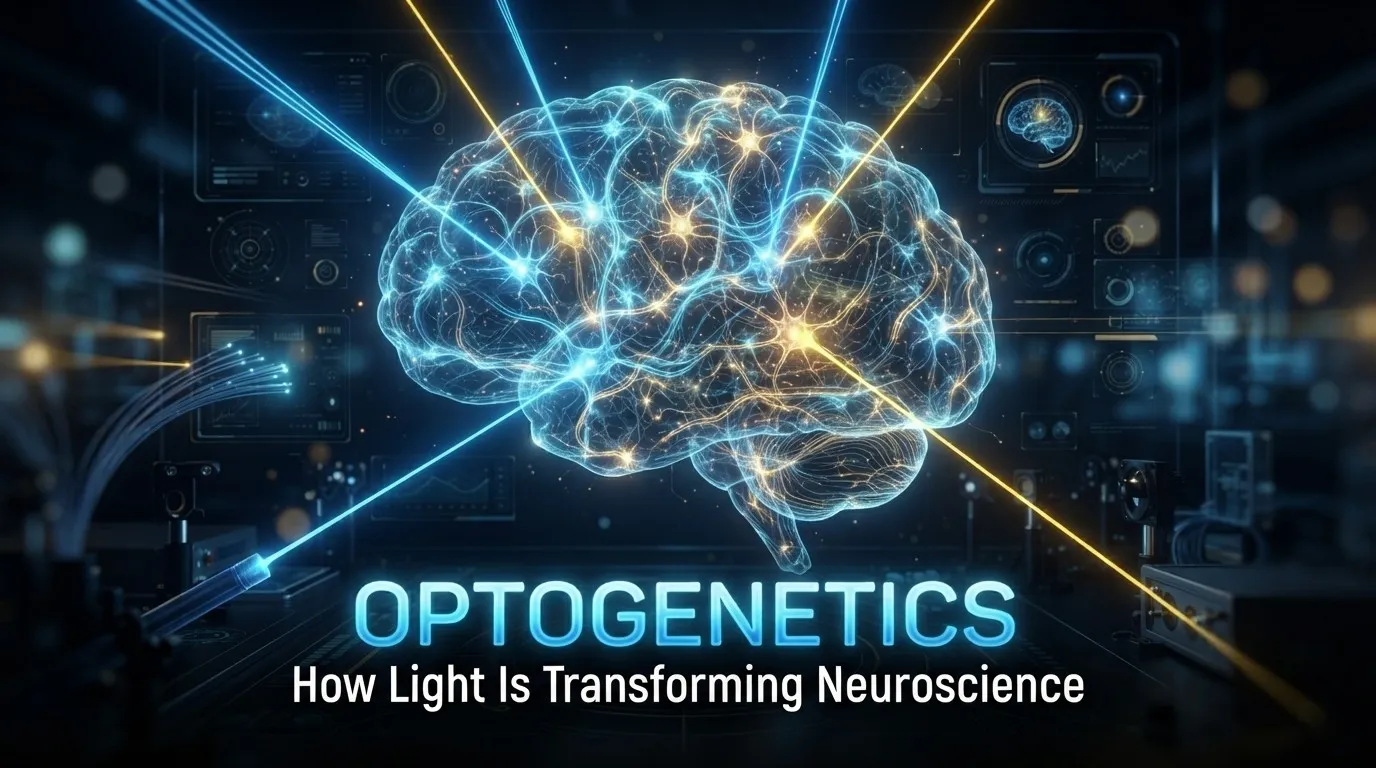
What if scientists could use light to control specific neurons in the brain and investigate how they influence movement, memory, emotions, and behaviour? This is the principle behind optogenetics, a powerful research technique that combines genetics and optical technology to study the nervous system with remarkable precision.
On October 5, 2026, the Nobel Prize in Physiology or Medicine was awarded to Karl Deisseroth, Peter Hegemann, and Georg Nagel for their discoveries concerning light-gated ion channels and optogenetics. Their work connected the discovery of light-sensitive proteins in microorganisms with the ability to control neuronal activity using light, transforming how scientists investigate the brain.
The Discovery Behind Optogenetics
The development of optogenetics began with research into Chlamydomonas reinhardtii, a single-celled green alga that responds to light and adjusts its swimming behaviour accordingly.
Peter Hegemann investigated the mechanisms underlying light detection in these organisms, while Georg Nagel contributed to the discovery and characterization of channelrhodopsins, light-sensitive proteins found in algae.
One particularly important protein is channelrhodopsin-2 (ChR2). This protein functions as a light-gated ion channel embedded in the cell membrane. When exposed to blue light, the channel opens and allows positively charged ions to cross the membrane.
This discovery established a fundamental principle: light could be used to influence the electrical activity of cells through a naturally occurring biological mechanism.
Karl Deisseroth and his collaborators subsequently helped demonstrate how channelrhodopsins could be used to control the activity of mammalian neurons. This development established optogenetics as a powerful experimental method for investigating neural circuits.
How Does Optogenetics Work?
Optogenetics involves introducing genes encoding light-sensitive proteins into selected cells, enabling researchers to influence cellular activity using specific wavelengths of light.
The process can be understood through three main stages.
1. Genetic Targeting of Light-Sensitive Proteins
Researchers introduce genetic instructions encoding a light-sensitive protein, such as ChR2, into selected cells using an appropriate gene-delivery or genetic-engineering method.
The targeted cells then produce the protein, which becomes incorporated into their cell membranes. Depending on the experimental design, researchers can target particular neuronal populations to investigate their individual functions.
2. Activation by Light
When cells expressing ChR2 are exposed to an appropriate blue-light stimulus, the channels open and permit positively charged ions to cross the cell membrane.
ChR2 is a nonselective cation channel. It conducts several types of positively charged ions, including sodium, hydrogen, and calcium ions, with different degrees of permeability.
The resulting inward electrical current typically depolarizes the cell membrane, making the neuron more likely to generate an action potential.
3. Control of Neuronal Activity
If the membrane depolarization reaches the threshold for firing, the neuron generates an action potential, an electrical signal that propagates along its membrane.
By controlling the timing, intensity, and location of illumination, researchers can investigate how selected neurons influence other cells and larger neural circuits.
Different light-sensitive proteins can produce different effects. Some promote neuronal excitation, while others can inhibit cellular activity through distinct mechanisms. Therefore, optogenetics is not simply a universal on-and-off switch; its effects depend on the protein used, the targeted cells, and the experimental conditions.
Why Is Optogenetics Important in Neuroscience?
The brain contains billions of neurons that communicate through complex networks. Understanding how these networks produce behaviour requires researchers to investigate not only which neurons are active but also how their activity contributes to specific outcomes.
Optogenetics allows researchers to manipulate selected neural populations and observe the resulting changes, helping them investigate cause-and-effect relationships in neural circuits.
1. Understanding Neurological Disorders
Optogenetics is used in experimental research to investigate neural circuit dysfunction associated with conditions such as Parkinson's disease and epilepsy.
For example, researchers can manipulate selected neuronal populations in laboratory models to examine how changes in circuit activity influence movement or seizure-related processes.
These investigations can improve understanding of disease mechanisms and help identify potential directions for future research. However, findings from experimental models do not automatically translate into effective human treatments.
2. Investigating Memory, Learning, and Behaviour
Memory formation, learning, motivation, and emotional responses involve interactions between multiple brain regions and neuronal populations.
Optogenetics enables researchers to activate or inhibit selected cells under controlled conditions and examine how these interventions influence behaviour.
This approach can help scientists identify the contributions of particular neural circuits to complex cognitive and behavioural processes.
3. Exploring Potential Therapeutic Applications
Researchers are investigating whether optogenetic approaches could eventually contribute to treatments for selected medical conditions.
One important area is optogenetic vision restoration, which aims to make certain retinal cells responsive to light by introducing genes encoding light-sensitive proteins.
A clinical study published in 2026 investigated an optogenetic treatment for people with advanced retinitis pigmentosa, an inherited retinal disease that can cause severe visual impairment. The study reported increased light sensitivity in some participants, although the results came from a small study and further research is needed to establish the treatment's safety and effectiveness.
Other potential applications remain under investigation. Optogenetics should not be presented as an established treatment for neurological or psychiatric disorders simply because it has shown promise in experimental research.
Challenges and Limitations
Despite its advantages, optogenetics presents several technical and biological challenges.
Delivering genetic instructions to the correct cells, achieving appropriate protein expression, and directing light to the intended tissue can be difficult. Light penetration is limited in biological tissue, particularly in deeper brain structures, which can complicate experiments involving deep neuronal populations.
Researchers must also consider possible tissue heating, unintended cellular effects, and the specificity of the genetic targeting method.
Furthermore, findings from animal models and laboratory experiments require careful evaluation before they can be applied to human medicine. Safety, effectiveness, delivery methods, and long-term outcomes must be assessed separately for each potential clinical application.
The Future of Optogenetics
Optogenetics represents an important advance in neuroscience because it allows researchers to investigate how the activity of selected cells contributes to the functioning of neural circuits.
By combining genetics, molecular biology, neuroscience, and optical technology, the technique provides a way to manipulate cellular activity with precise timing and examine the consequences.
The discovery of light-sensitive proteins in algae and their subsequent application to mammalian neurons demonstrate how fundamental biological research can lead to transformative scientific tools.
As research continues, optogenetics may provide deeper insights into neurological disorders, sensory processing, memory, and behaviour. It may also contribute to the development of selected therapeutic approaches, although these possibilities require continued scientific and clinical evaluation.
Optogenetics does more than allow scientists to observe neuronal activity. It helps them investigate how the activity of specific cells contributes to the function of the brain.