Adaptive Learning: When Education Learns From the Learner
By Smita Pandey
4 min read
Rethinking the One-Size-Fits-All Model
For decades, education has largely followed a standardized model. A curriculum is designed, teachers deliver the prescribed content, students follow a similar sequence, and learning is evaluated through periodic assessments. This structure has provided consistency and scale, but it is built around an assumption that deserves reconsideration: that learners can progress through education in approximately the same way.
They cannot.
Every learner enters the classroom with a different level of prior knowledge, pace of understanding, strengths, learning behaviour, and areas of difficulty. One student may understand a concept after a single explanation, while another may need visualization, examples, repetition, or additional practice.
This raises an important question for modern education: If learners are different, should learning remain the same for everyone?
What Is Adaptive Learning?
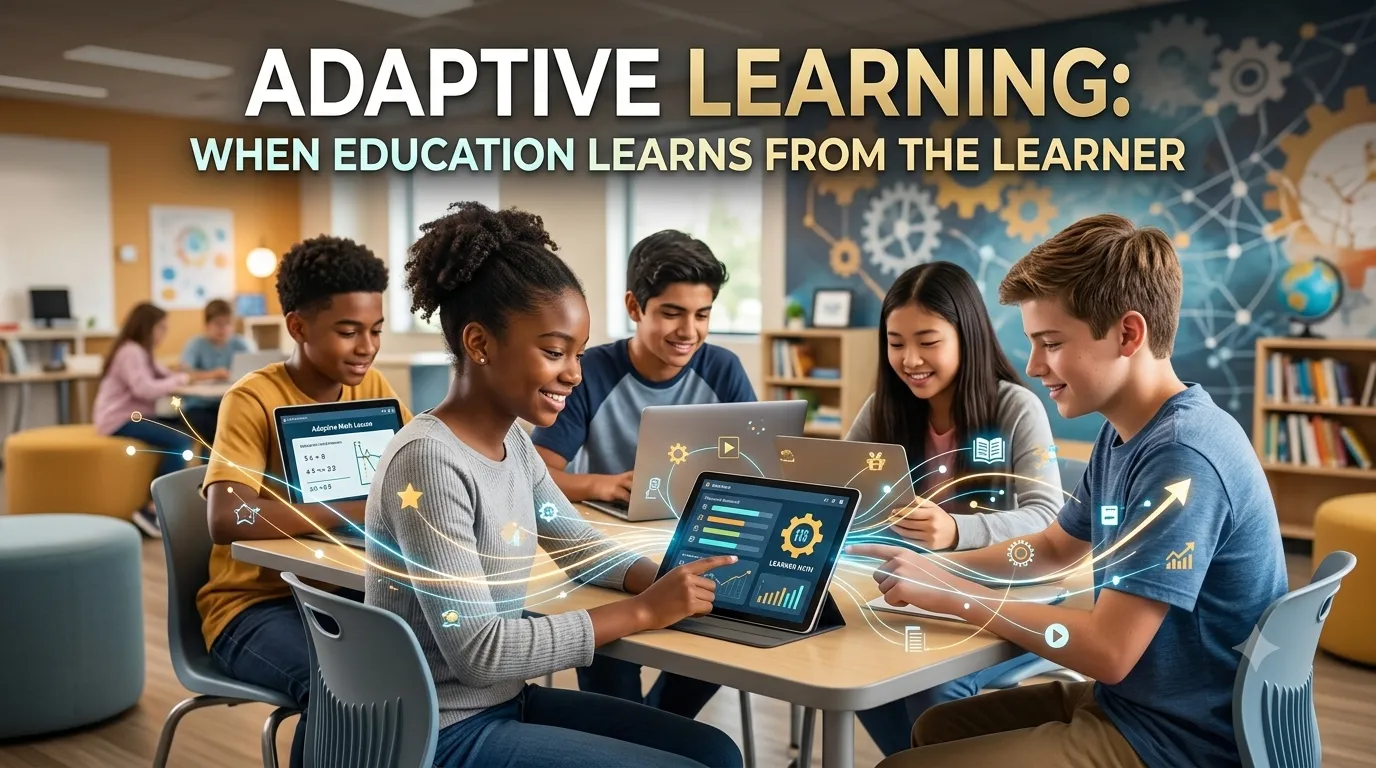
Adaptive learning offers a different approach. It uses technology and learning data to make education more responsive to individual learners.
Instead of simply delivering the same content to everyone, an adaptive learning system can analyse responses, assessment performance, practice patterns, and areas of difficulty to help determine what a learner may need next.
An incorrect answer is not merely a mark lost. It can provide evidence of a possible conceptual gap. Consistent success may indicate readiness for greater complexity, while repeated difficulty may signal the need for additional explanation or targeted practice.
In this approach, assessment becomes part of learning rather than simply a measurement at the end.
Understand → Assess → Identify → Personalize → Practice → Reassess → Progress.
The Role of Artificial Intelligence
Artificial intelligence is expanding the possibilities of adaptive education. AI-powered learning environments can analyse patterns across assessments, questions, responses, and learning interactions.
This can support personalized practice, targeted revision, appropriate levels of challenge, and more relevant learning recommendations.
However, the real innovation is not simply using AI to generate more educational content. The greater opportunity lies in using intelligence to determine which learning experience may be most useful for a particular learner at a particular stage.
BYOL Academy’s Vision: Making Learning Truly Adaptive
At BYOL Academy, our vision is to move education beyond the idea that every learner should follow the same path to achieve the same outcome.
We envision an education system in which every learner is understood as an individual—not defined simply by marks or rankings, but by their knowledge, progress, strengths, misconceptions, pace, and potential.
Through adaptive learning, BYOL Academy aims to create a continuous intelligence loop between the student, learning content, assessment, feedback, teacher, and school.
Our goal is simple but ambitious: to make learning more personal for students, more transparent for parents, more insightful for teachers, and more effective for schools.
For Students: A Learning Path That Understands Them
Students should not have to spend equal time on everything.
Adaptive learning can help students identify what they already understand, where they are struggling, and what they should focus on next. Instead of learning only for the next examination, students can gradually develop greater ownership of their learning.
The objective is to encourage students to become active participants in their education, building confidence through progress and learning from mistakes rather than being defined by them.
For Parents: Turning Concern Into Meaningful Insight
Parents want more than a report card. They want to understand whether their child is genuinely learning, where difficulties exist, and how they can provide the right support.
BYOL Academy aims to give parents a clearer picture of the learning journey through meaningful performance insights. Instead of focusing only on marks, parents can gain a broader understanding of strengths, learning gaps, progress, and areas requiring attention.
The purpose is not to create pressure for children, but to create better communication between student, parent, teacher, and school.
For Teachers: From Teaching Everyone to Understanding Everyone
Teachers remain at the centre of education.
Adaptive technology can support teachers by providing structured insights into student performance, helping them identify common learning gaps as well as individual difficulties. This can make classroom intervention more focused and allow teachers to spend more time on explanation, mentoring, discussion, and higher-order learning.
Technology provides the data. Teachers provide the understanding.
For Schools: Building an Intelligent Learning Ecosystem
For schools, adaptive learning can create a more connected approach to teaching and learning.
By bringing together student performance, assessment insights, personalized practice, and teacher feedback, schools can move towards a learning environment that is more responsive and evidence-informed.
The vision is not to replace the existing education system, but to strengthen it with intelligence.
The Future of Learning
Adaptive learning does not require a completely different curriculum for every student. It recognizes that learners may share the same educational goals while requiring different pathways to reach them.
This represents a fundamental shift in educational philosophy.
In traditional education, the learner adapts to the system. In adaptive education, the system begins to adapt to the learner.
For BYOL Academy, that is more than an advancement in educational technology.
It is a vision for an education system that understands the learner, supports the teacher, informs the parent, strengthens the school, and empowers every student to progress toward their potential.